Cybercratic Imperialism

When one thinks of a monopoly, what set of attributes would generally come to mind? How about imperialistic feudalism? what set of attributes and modes of operations would one confer onto these methods of socioeconomic modeling? For a time, try to envision a subsequent reality, not too distant in the future ( ~ 40-50 yrs), when a certain set of institutionalized companies, operating on the basis of resource accumulation and share price maximization, would ultimately converge unto a pocket of locality that would entail a sort of quasi-governmental structure based on a system of Cybercratic Imperialism, manifesting itself by a revival of a manorial ethos, whereby positions in such companies are nothing more than a euphemistic guise for indentured servitude - serfdoms. This presupposes a massive shift or global event that would usher in newer paradigms/modes of operation on a socioeconomic level. Although this essay generally sheds light on a more pessimistic perspective of the eventual terminus of our current hyperconsumerist/ accelerationist path for progress - progress that can manifest itself on either end of the axis of what can be deemed morally good or evil, or malignant or benevolent - I still have some hope for a less drastic outcome.
I must establish some parallels. In medieval times, across large numbers of people and ethnic groups across the world, a feudalist mode of socioeconomic operation was commonplace. The lords held large amounts of wealth, generally taking the form of large swathes of land, bountiful crop yielding farms - in places with such conducive climate, cattle - and -especially in the case of monarchical societies, the favor of the preeminent monarch. These would tend to manifest themselves as forms of wealth and abstractions of individual sovereignty during those times. The lords had vassals. These were a sort of ‘crew’ or ‘disciples’ that would plead their allegiance to their lords and the crown - most times in exchange for a place to live or food to eat. It was a step above being an indentured servant and came with substantially more societal prestige. Protect and plead allegiance to your lord, and you will always have a “home” and are less likely to fall prey to the malignant whims of the nobility class. These vassals of middle age times are generally analogous to modern-day white-collar individuals. People who are generally characterized by being “upwardly mobile” young to middle-aged professionals. They plead fealty to their cybercratic imperialist by helping build and maintain those structures because the benefits eventually trickle down to them to a greater extent relative to the lowly serfs they try so hard to cache their societies from.
The serfs, in this context, can be thought of as “consoomers”, operating on the basis of hyperconsumerist ethos. Consoom! consoom! consoom! until you are effectively incapable. These people have no such proximity to any ounce of power. They spend their days being, in most contexts of the word, wire-headed. The reality of the material world they had ancestrally inhabited, in all its absolute rawness, has either become too much to bear or, the overlay reality in which they inhabit, which was categorically created by their cybercratic lords, is just that much better. A world where one has no responsibility, no expectations, no duty, and not a modicum of culpability given their actions. A world where one can decide to turn all their pleasure centers to overdrive and exist in a state of constant docile catatonia is a world where one becomes the optimal sheep.
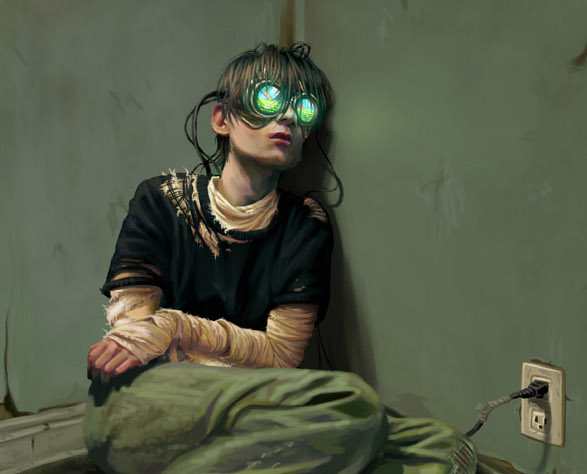
When this idea comes to mind, I often wonder how it would play out in a geopolitical context, across countries with wildly differing cultural norms. For example, given the conservative ethos of a good number of west African countries, how would the introduction of these new forms of socioeconomic modeling play out? Would such an eventual terminus presuppose a globalized world? or a world predicated on network states bound by c and cyberspace protocols rather than geographically land-bordered states? One could see how “countries” would be made up not of ethnic affiliations or racial epithets, but instead shared interests in cyberspace. Given the current state of blockchain-based technology, such a future is ever more tangible. Already, online communities are akin to quasi-tribes. The concept of “in-groups” and “out-groups” seems to be gaining more traction in mainstream outlets, or that is at least what it seems like from my vantage point.
The primary mechanism that “governments” in the conventional sense have employed to propagate sovereignty over its citizens and other countries entails a monopoly on power and control of the medium of exchange. The emergence of blockchain-based back-end solutions eradicates the presumed sovereignty of governments in the dimension of efficient exchange mediums. Any sufficiently skilled 16-year-old could program an algorithmic stable coin. That is the first step to establishing such a nation. Said stable coin could be pegged to the currency of the most economically powerful/influential government. This would be done as a game-theoretic based preemptive action to nullify any such economic attack from the said powerful government because to devalue the worth of the algorithmically pegged stable coin is to destroy its sovereignty. For the second and, in my opinion, the prime dimension for the fight for cyberspace-based sovereignty is the acquisition of power - military power. It is not immediately obvious to me how this would be resolved. Given my ideation of the dystopian version of the terminus of our current trajectory, one could see how such institutionalized companies, which would become quasi-monarchical structures manifested as a cybercratic dystopia, would have accumulated enough wealth, primarily from the wire headed serfs to the extent that the wealth they hold far surpasses that of any government in the traditional sense. In such cases, the method by which a monopoly on violence is executed becomes much more obvious.
I could also go more into detail about how these “cyberstates” would likely manifest themselves, but that would be for a much longer post. Also, a lot of other sources have already dug extensively into that so I’d rather not “re-invent the wheel” in this scenario.
Just to reiterate, these futurist ideations can end up either rather utopian or utterly dystopian, there’s almost no middle. My last few paragraphs have been an attempt to shed light on the more dystopian perspective of the eventual terminus of our current accelerationist/hyperconsumerist culture. I really hope that this ends up more towards the utopian side because I really want to live forever, in the most absolute sense. My reasons are simple, I want to live forever in order to experience all qualia and acquire all knowledge available. It will always be a battle against more evil forces of humanity, and it seems like the great filer might not be escapable, or that is at least what it seems like from my “monkey” perspective. In the event that humanity manages to pass all the seemingly major great filter challenges, whether, via utopian tending technological progress, or dystopian methods that leave much of the population effectively catatonic, it will then become a battle against entropic forces, which in my opinion for whatever its worth, is a much less pressing force.